MODELS
Isuzu Cancels the D-Max EV and Leaves the Plug-In Gap
Isuzu cancelled the D-Max EV after HiLux BEV sales of 30 a month, just as a plug-in hybrid passed it in 4×4 sales.

Isuzu Ute Australia has cancelled the D-Max EV for local launch, citing weak demand and Toyota HiLux BEV sales of about 30 a month. Rod Caldwell, executive general manager at the importer, said the electric truck would probably take a third of that, or about 10 a month.
The ute Isuzu is holding back still matches diesel towing at 3500kg. A plug-in hybrid rival has already slipped past the D-Max in 4×4 sales, and Caldwell still will not name a hybrid or PHEV for Australia.
Isuzu Will Not Export the Current D-Max EV
Isuzu Motors International Operations Thailand, the arm that ships the D-Max, said on 30 September 2026 that it would not export the battery-electric model “at this time” because it needs to put products that fit current customer needs first. Caldwell, who speaks for Isuzu Ute Australia, put it in fewer words.
We’ve got a competitor out there, a big competitor, who’s got a BEV ute and it’s selling about 30 a month. And so probably we think we’d get a third of that. The customers are not looking for that.
Rod Caldwell, executive general manager, Isuzu Ute Australia
He added that customers are not screaming for a battery ute, and neither are dealers, so the company does not want to “shove it down their throat just for NVES.” If the truck sold 10 a month, he said, it would not make much of a difference. Diesel still accounted for 84 per cent of light-commercial sales in the year to that announcement, on Isuzu’s own tally.
Australia had been named in the global D-Max EV rollout in 2024, alongside the United Kingdom and Thailand. Production of the left-hand-drive truck began in Thailand in April 2025, with right-hand-drive builds following for the UK in 2026. Seventeen months after that production start, the current battery D-Max is off the Australian plan.
THE ROLLBACK
- March 2024: Isuzu names Australia among markets for the electric D-Max, with the UK and Thailand.
- 29 April 2025: Mass production of the D-MAX EV starts in Thailand for Europe, with UK sales slated for 2026.
- 25 September 2025: Isuzu Ute Australia launches a more efficient 2.2-litre diesel and eight-speed auto instead of a plug-in.
- May 2026: The Toyota HiLux BEV reaches Australian showrooms as a low-volume fleet ute.
- June 2026: Isuzu’s Earth Lab electric-development centre opens in Japan.
- 30 September 2026: Thailand’s export arm stops the current BEV D-Max for Australia.
- 19 October 2026: Caldwell says a dedicated team is still waiting on Earth Lab for a fit-for-purpose powertrain.
The halt covers this battery D-Max, not every future electric idea. Caldwell has already said there is still no firm hybrid, diesel-hybrid, or PHEV path for Australia, only a judgement that the battery ute “right now, doesn’t work.”
The Electric Ute That Still Tows 3500kg
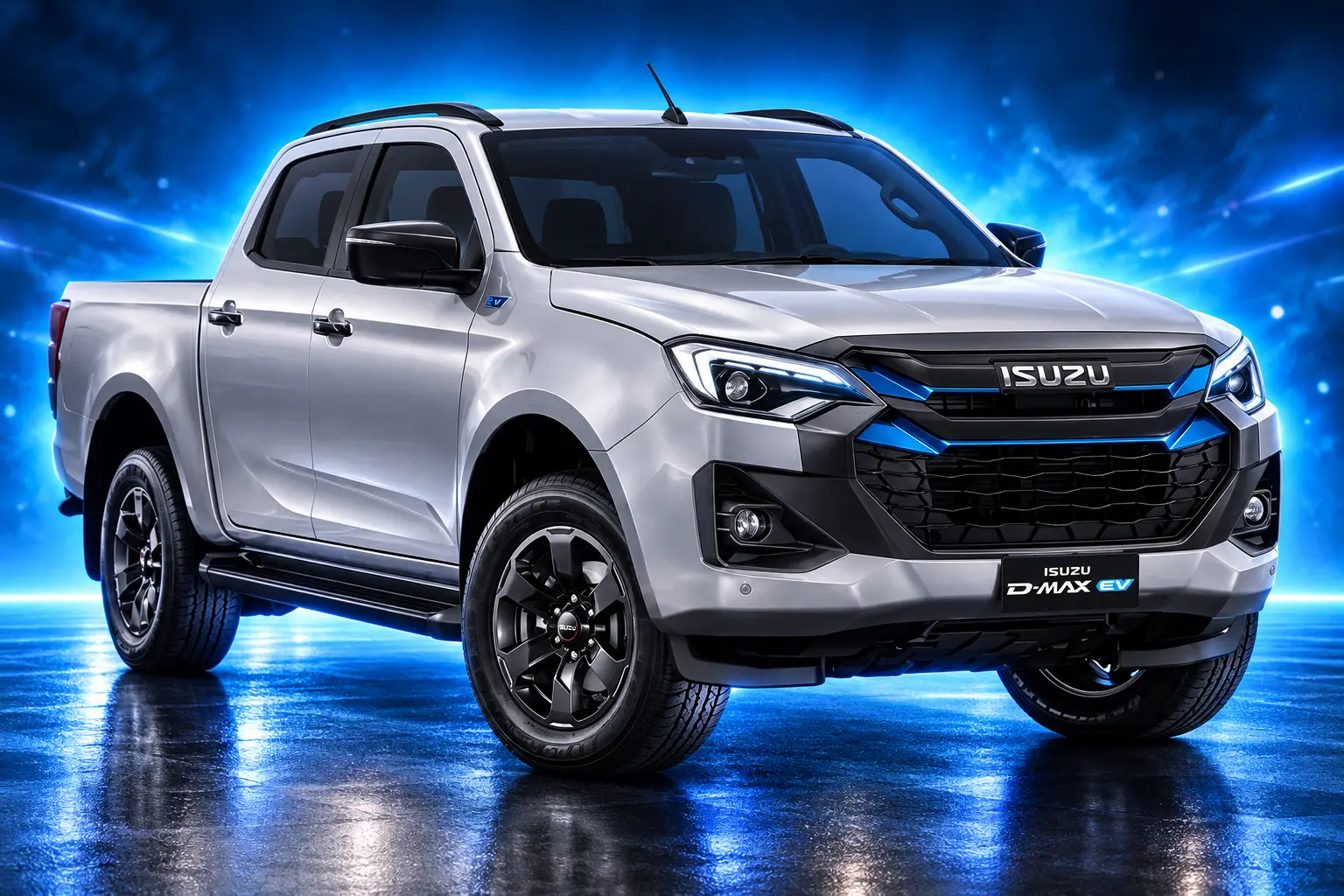
The product being withheld is not a city runabout with a tray. Isuzu’s published European spec gives the crew-cab D-MAX EV dual motors for 140kW and 325Nm, a 66.9kWh lithium-ion pack under the floor, and 3500 kg of braked towing with a 1010kg payload. Curb mass is 2350kg. Claimed 0-100km/h is 10.1 seconds, and WLTP range is 263km, or 361km in the city cycle, at 255Wh/km.
The front motor is rated at 43kW and 108Nm, the rear at 97kW and 217Nm. AC charging is capped at 11kW, or about 10 hours from empty to full. DC charging tops out at 50kW, with 20 to 80 per cent listed at one hour. Full-time 4×4 uses e-axles at both ends. In Thailand the EV opens at 1,591,000 baht, about $67,800, against a local diesel D-Max from 595,000 baht.
The Toyota HiLux BEV that Caldwell used as his demand test is priced from $74,990 before on-roads for the SR cab-chassis, $76,490 for the SR pick-up, and $82,990 for the SR5 pick-up. Braked towing is 2000kg. Toyota’s sales boss John Pappas forecast 500 HiLux BEV sales in 2026, aimed at mining, construction, and government fleets, or about one per cent of typical HiLux volume. Caldwell’s “30 a month” sits under that already modest target, and he still used it to kill a truck that keeps the 3500kg rating diesel buyers treat as the point of a one-tonne ute.
HOW THE TWO ELECTRIC UTES COMPARE
| Spec | D-Max EV | HiLux BEV | D-Max 3.0 diesel |
|---|---|---|---|
| Combined power | 140kW | 144kW | 140kW |
| Combined torque | 325Nm | 468Nm | 450Nm |
| Battery | 66.9kWh | 59.2kWh | n/a |
| Claimed range | 263km WLTP | Toyota fleet cycle, pick-up about 245km WLTP | n/a |
| Braked towing | 3500kg | 2000kg | 3500kg |
| Payload | 1010kg | Not used here (figures conflict) | About 1000kg |
| DC charge | 50kW | 150kW | n/a |
| Australian price | Not coming | From $74,990 plus on-roads | From $36,200 plus on-roads |
The payload cell for the HiLux BEV is left blank on purpose, because published figures do not agree. Towing is the clean split: the cancelled Isuzu matches the diesel D-Max, and the Toyota that “proved” the market is a 2000kg truck.
A Plug-In Hybrid Has Passed the D-Max in 4x4s
The demand story changes once the tape includes a plug and a tank. The BYD Shark 6, a plug-in hybrid dual-cab, recorded 18,073 Australian deliveries in 2025, according to Federal Chamber of Automotive Industries figures, making it the country’s fifth-best-selling ute that year behind the Ranger, HiLux, D-Max, and Triton. Isuzu delivered 26,839 D-Max utes across single-cab, extra-cab, cab-chassis, and 4×2 grades in the same year, so the diesel range still won on total volume.
In 4×4 standings it is tighter. VFACTS figures for September 2026 put the Shark on 1492 four-wheel-drive sales for the month and 13,586 for the year to date. The D-Max recorded 1393 4×4 sales in September and 13,340 for the year, so the Chinese plug-in sat 246 units ahead of Isuzu’s core 4×4 tally. Ford’s Ranger led 4x4s on 4824 for the month, with the HiLux on 3975.
That 4×4 lead is not a win over the whole D-Max line. Through August 2026, all D-Max grades had 16,371 deliveries against 12,094 for the Shark 6, because Isuzu still sells 4×2 and cab-chassis trucks the BYD does not fully copy. The buyers overlapping a dual-cab 4×4 D-Max, the people who actually shop an electrified ute, are the ones already moving.
UTE SCOREBOARD, YEAR TO SEPTEMBER 2026
| Model | September 4×4 | 4×4 year to date |
|---|---|---|
| Ford Ranger | 4824 | 35,744 |
| Toyota HiLux | 3975 | 32,238 |
| BYD Shark | 1492 | 13,586 |
| Isuzu D-Max | 1393 | 13,340 |
| Mitsubishi Triton | 1016 | 11,821 |
Ford and GWM already sell plug-in hybrid utes in the same lane, the Ranger Hybrid and Cannon Alpha PHEV. KGM’s Musso EV is the other battery ute on sale, a unibody, and MG’s U9 EV is still listed as coming. The electric one-tonne class Caldwell pointed at remains tiny. The plug-in class is not.
THE 2025 PLUG-IN BENCHMARK
- Shark 6, 2025: 18,073 deliveries, Australia’s best-selling plug-in hybrid in a single year.
- D-Max, 2025: 26,839 across a much wider cab and drivetrain mix.
- HiLux BEV, 2026 target: 500 units for the full year, by Toyota’s own forecast.
- Isuzu’s EV guess: about 10 a month, Caldwell’s third of the HiLux BEV run-rate.
A battery D-Max at 10 a month would not have recaptured those 4×4 buyers. A plug-in that still tows and still fills from a bowser is the product those numbers describe, and it is the product Caldwell still will not schedule.
Why a 263km Range Killed the Business Case
Caldwell did not hide the mechanical reason. The overseas electric D-Max still has 3.5-tonne towing and a one-tonne payload, he said, “but it’s the range that would probably have an impact to our customer’s buying decision.” WLTP 263km is a full-day problem once a fridge, a canopy, and a trailer go on, and 50kW DC is slow by 2026 passenger-car standards. Overnight 11kW charging assumes a depot or a house with three-phase power, which many private dual-cab buyers do not have on a job site.
That pack and that charge rate were easy to read as a compliance special even before the axe. A 263km ladder-frame EV lets a maker print a zero-tailpipe brochure without building a truck people will take 400km to a fence line. Toyota, at least, priced the HiLux BEV as a fleet tool and said so. Isuzu looked at those 30 monthly sales, inferred a 10-unit fate for itself, and walked away from a more capable chassis rather than wait for a bigger battery.
In Australia the cheapest diesel D-Max still starts at $36,200 before on-roads. A UK-spec electric D-Max has been discussed locally as a truck that would have landed near $100,000. Even without a locked local sticker, that gap, on top of 263km, is a different product from a $55,900 to $62,900 Shark 6. Caldwell’s line that a battery one-tonne ute “is not the answer” fits this hardware. It does not, on its own, explain a blank space where a PHEV should be.
The 2.2-Litre Diesel Carries the Emissions Load
The substitute Isuzu did ship is another oiler. On 25 September 2025, managing director Junta Matsui said the company’s Australian rise had been built on listening for value, durability, and performance, as Isuzu Ute Australia rolled out a 2.2-litre RZ4F turbo-diesel and eight-speed auto. The Euro 5 four-cylinder makes 120kW and 400Nm, with combined fuel use from 6.3L/100km, and 3.5-tonne towing is now standard across the D-Max and MU-X range. The 1.9-litre engine and the manual gearbox are gone.
The long-running 3.0-litre 4JJ3-TCX stays on sale at 140kW and 450Nm with a six-speed auto, now with idle stop-start. That is the same 140kW peak as the cancelled EV, with 125Nm more torque. Caldwell has tied the 2.2, plus a wider MU-X mix, to the New Vehicle Efficiency Standard, the federal fleet-CO2 rule that started on 1 January 2025 with reporting from 1 July 2025.
WHAT ISUZU IS SELLING INSTEAD
- The 2.2 diesel: 120kW, 400Nm, eight-speed auto, from 6.3L/100km, 3500kg towing on every grade.
- The 3.0 diesel: 140kW, 450Nm, still the performance engine, now with stop-start.
- A wider MU-X range: more variants of the related wagon to spread the same engines across more buyers.
- No plug-in: Caldwell said on 30 September he could not promise a PHEV, a diesel hybrid, or any hybrid.
Matsui’s “listening to customers” line and Caldwell’s “dealers are not screaming” line are the same bet: keep the oil-burners that still take 84 per cent of the light-commercial chart, and treat electrification as a lab problem rather than a showroom one.
Buying Credits Instead of Shipping Battery Packs
The New Vehicle Efficiency Standard does not ban diesels or force a BEV onto a ute roster. Each supplier gets a fleet-average CO2 target. Beat it and you earn units; miss it and you have two years to trade or generate credits before a penalty is payable. The Department of Infrastructure’s own FAQ calls the scheme technology-neutral, covering more efficient petrol and diesel as well as hybrids and electrics, and it states that utes and 4WDs remain legal to sell.
Caldwell has been blunt that a 10-a-month BEV would not deliver the NVES result Isuzu wants. “We don’t want to bring this car into the market just because of NVES, it’s just not going to create the result that we’re looking for,” he said on 19 October 2026. He has also said Isuzu Ute Australia will not refuse credit trading, “buying credits from those who have excess,” and that the importer will try to absorb NVES cost inside the business rather than pass a fine straight to D-Max buyers.
That is a coherent accountant’s path for a two-model diesel importer. It is also a path that leaves the 4×4 dual-cab customer who already bought 18,073 Shark 6s in 2025 with nothing wearing an Isuzu badge. Credits clear a ledger. They do not tow a van or hold a place on a dealer’s board against a plug-in that is already outselling the D-Max in 4×4 form.
Earth Lab Is Running, Australia Still Waits
Isuzu’s longer answer sits in Japan. Caldwell said the company has a dedicated powertrain team and is working with The EARTH lab at the Fujisawa plant, a five-storey electric-development centre of about 27,000 square metres that Isuzu budgeted at about 40 billion yen. Operations were planned for June 2026 and the newsroom listed the lab as open from 29 June 2026. The name stands for Electric Automotive Research and Test Headquarters. The kit covers batteries, motors, EV systems, and thermal management, aimed at a full carbon-neutral commercial range by 2030.
On 19 October, three weeks after the Australian axe, Caldwell still would not pick a plug-in, a diesel hybrid, or a better BEV. “We still don’t know what the Earth Lab is going to present to us as the best solution for Australia,” he said. He has previously pointed to an eight-year lifecycle that would put the next D-Max and MU-X around 2028. Until that truck exists, the current-generation Australian range stays diesel, with credits as the bridge.
WHAT WE KNOW
- This BEV: The current D-Max EV will not be exported to Australia at this time.
- This diesel: The 2.2 and 3.0 oilers, plus a wider MU-X mix, are the local emissions tools.
- This lab: Earth Lab is open in Fujisawa and is the named source of a future low-CO2 powertrain.
WHAT IS UNCONFIRMED
- A plug-in D-Max: Caldwell said there is still no firm PHEV, HEV, or hybrid direction for Australia.
- A later BEV: A longer-range, cheaper electric D-Max has been talked about as possible, not planned.
- A 2028 date: A new generation around 2028 follows from the eight-year cycle remark, not a locked launch.
Caldwell’s last useful sentence is also the flattest. He supports future electrification, he said, and a battery-electric one-tonne ute is not the answer. Earth Lab has not yet told him what is.